Report
Fueling change: leveraging the Social Climate Fund to prepare for the next fossil crisis in Europe
While Europe was living through one of its hottest summers on record, causing tens of thousands of casualties and an estimated 180 billion euros in economic damages, EU governments had to react to the energy crisis that resulted from the continuing Iran war. The persistent hostilities have kept fossil prices (and inflationary pressures) dangerously high. EU countries have shouldered an additional 100 billion euros burden to import fossil fuels since the start of the Iran war.
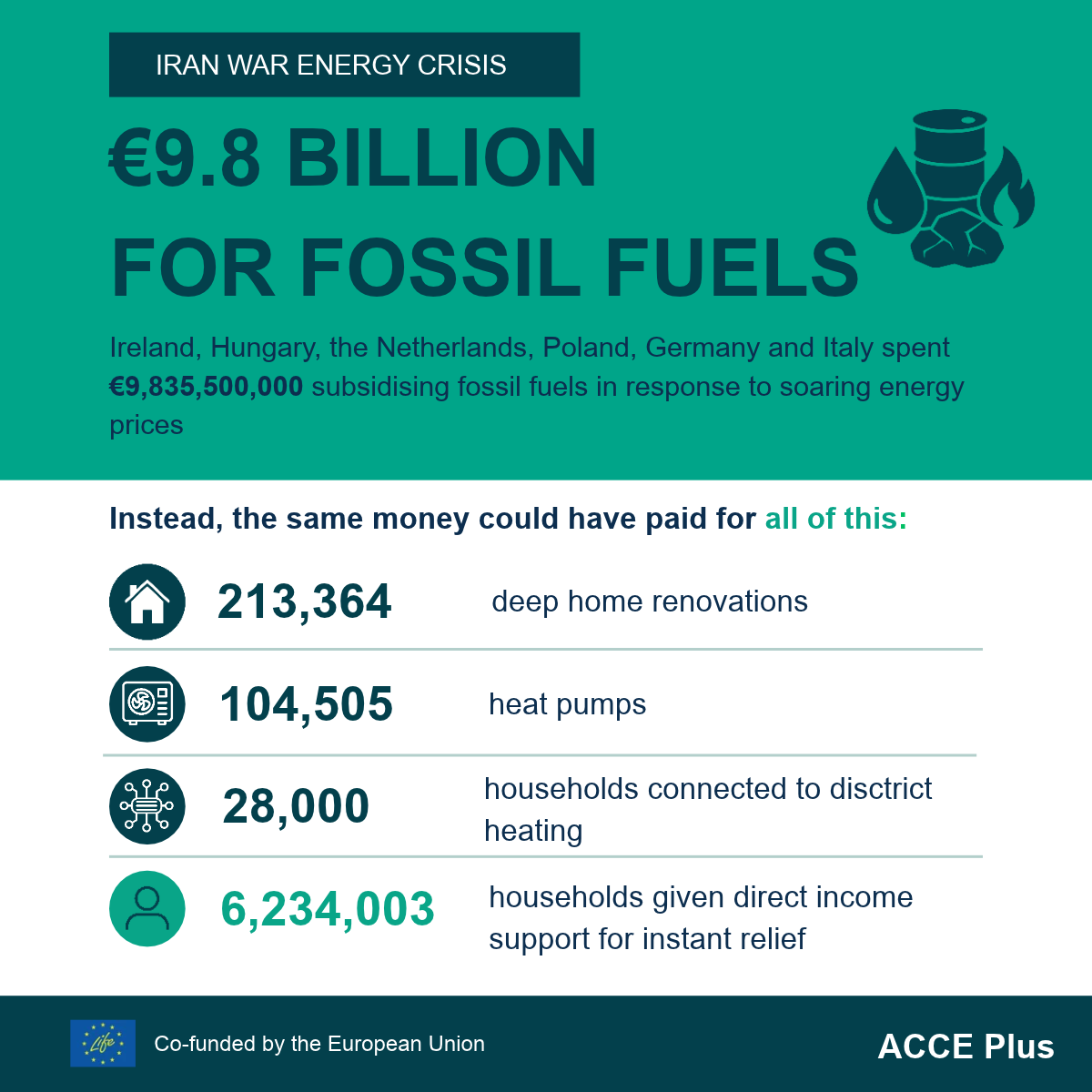
In an attempt to cushion the energy price increases caused by the war in the Middle East, many EU countries have reduced taxes or provided other types of subsidies for fossil fuels. However, subsidising fossil fuels stimulates their consumption at a time when climate sciences indicates a clear need to shift away from fossil fuels. Out of the €11.8 billion in fiscal measures that EU governments have implemented to cushion the impacts of the Israeli-US-Iran war on energy bills, €10.19 billion actually increases fossil consumption - with only €0.41 billion leading to a decrease.
Moreover, these subsidies benefit mostly affluent individuals, as the wealthiest 10% of the EU population consume 8 times more transport fuel than the poorest 10%. Thus, the subsidy increases social disparities, which contradicts the EU’s aim of improving social cohesion.
The United Nations has, for the first time, warned that global warming will exceed 1.5°C in the next few years, indicating that global heating is accelerating faster than originally predicted. As the European Central Bank warns, fossil fuels - the main culprit of climate breakdown - are also a major threat to macroeconomic stability.
Accelerating the transition to sufficiency measures, homegrown renewables and energy efficiency is the surest way to build long-term resilience against fossil shocks. The EU strives to embed social considerations in the transition; hence the Social Climate Fund is a powerful tool that Member States can immediately rely on. Q3 2026 saw a noticeable uptick of EU countries submitting their Social Climate Plans (SCPs), with some already being approved. This unlocks much-needed funding for investments in electric mobility, public transport, renewable heating and cooling, and building renovations. For example, Sweden, the first country with an approved SCP, has already started disbursing its EV subsidy.
Structural measures may be complemented by direct income support (instead of subsidies at the pump) because direct support can be targeted to those who really need it, and it does not stimulate fuel consumption.