Stories
Success story – Belgian farms: Fertile ground for community energy
Community energy is key to action on the climate crisis. It can empower people, boost local economies, and reinvigorate communities. Community-led initiatives play an important role in the transition towards a 100% renewable and just energy future. Success stories of community energy projects can be found all over the world. At REScoop.eu we want to highlight these stories to further accelerate the movement towards a cleaner and democratic system. This month, we traveled around Belgium to hear more about how farmers are building innovative community energy projects across the country.
In Belgium, a wind of change is blowing in the countryside. In a rapidly changing world, with more unstable weather, fluctuating energy and food prices, and evolving legislation, farmers are thinking creatively about the future of their trade. Many have identified an opportunity: plugging into the transition to renewable energy.
In many respects, farmers are ideal initiators of local energy projects. “Farmers have a lot of assets to develop sustainable energy: space, knowing the environment very well, an awareness of the influence of the seasons. Farmers are first and foremost entrepreneurs; if they see opportunities in something, they will take matters into their own hands to take a key role in the rural environment,” noted Tom Schaeken, a former energy consultant in Boerenbond (the Farmers Association in Flanders). Farmers’ activities are also well suited to more flexible energy systems, as their energy needs change with seasons.
Solar orchards: agri-voltaics take off in Bierbeek
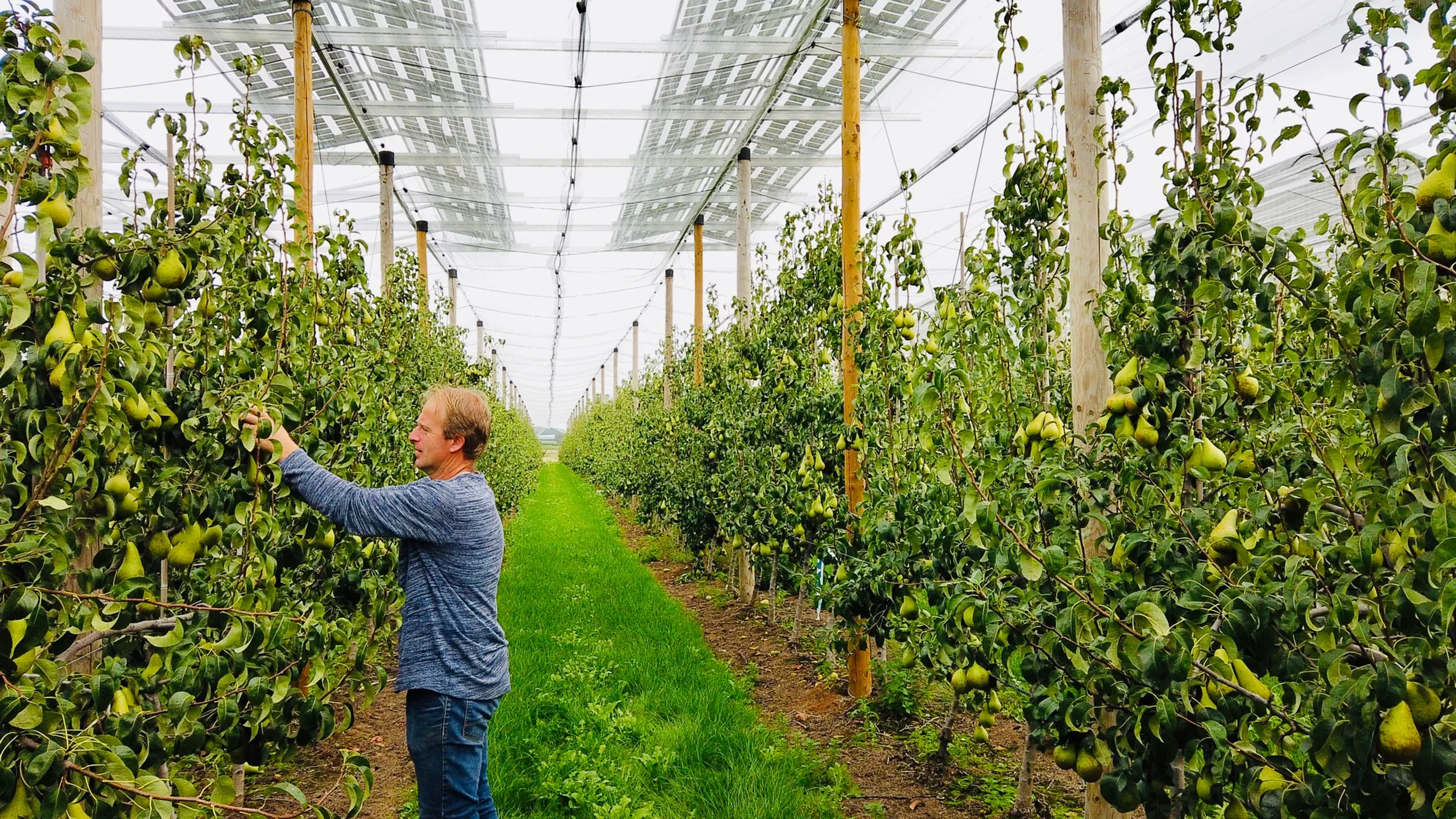
Our first stop is Bierbeek, a small town east of Brussels. In 2020, local farmer Jan Van der Velpen partnered with researchers from the university of Leuven to test a new idea: installing semi-transparent solar panels above crops – in this case, a pear orchard. The solar panels offered many potential benefits for the crops themselves: protecting pears from extreme weather, reducing diseases and pesticide use, and enabling rainwater collection. It was also an opportunity for Jan Van der Velpen to diversify his revenue.
Due to the partial loss of light, yields fell by around 15% after a few years, but the benefits (including energy generation) were sufficient to make it worthwhile – an encouraging first step that helped larger projects emerge across the country. And progress is ongoing: researchers from Leuven have tested rotating solar panels that follow the sun during the day, while the University of Hasselt experiments with solar coating for greenhouses.
In the spirit of cooperation, and to strengthen his community, Jan also invested in traditional rooftop solar panels on one of his warehouses with a local cooperative, ECOOB: “A project that not only generates energy for us, but also strengthens the connection with the neighbourhood. It shows how we work together with the community towards a sustainable future.”
“Powered by Farmers and Citizens”: a new energy cooperative is born in Hal
In northern Belgium, at the Dutch border, Halnet energy cooperative was founded in 2020. The idea emerged during a Boerenbond training session on energy savings, production, and flexibility. During the event, farmers voiced concerns about their geographical isolation and their potential disconnection from the grid in case of issues with nuclear energy supply – which could put livestock at risk. “We’re the end of the pipe”, summarised Tom Mertens, a local farmer who was one of the key drivers of Halnet.
A neighbourhood barbeque was organised with the residents of Hal to discuss creating a shared energy cooperative to build self-sufficiency. Enthusiasm bubbled, and eventually, they raised the money needed to start the project in just 10 days. “Farmers are used to collaborating – but for the first time, we’re also cooperating with local residents,” Tom told us. Today, Halnet brings together 40 residents and 20 farms, with four solar PV production sites and one 450 kWh battery. This includes agri-voltaic technologies: with the help of a public subsidy, Tom Mertens installed semi-transparent solar panels over berry bushes – ideal crops for agri-voltaics due to their need for shade and protection.
The barbeque has since become an annual event and has considerably strengthened ties in the community. “Every resident is proud of the project”, said Tom Schaeken. In 2023, the creativity of the energy cooperative's approach was recognised by the ARIA European award in 2023 in the category ‘Skills of stakeholders in the countryside’.
Today, Halnet’s focus is building a viable long-term economic model for the cooperative in the context of a fluctuating energy market. Tom told us: “With negative energy prices, curtailment, and rapid changes in energy markets, if you’re not careful, you can lose a lot of money very fast. We installed digital meters to balance production and consumption very precisely, to predict what we can inject into the grid, which allows us to offer stable energy prices. Adapting to the market was our biggest challenge: energy communities can help citizens understand what’s in their energy bill.”

Facing legislative limitations
Despite growing enthusiasm, both projects are constrained by regional legislation on energy sharing. Cas Lavaert, a researcher from the university of Leuven explained: “Energy sharing is possible between two entities, but complications emerge as soon as a third party is involved – forcing producers to share their energy for free, which doesn’t make economic sense.”
Like many others, Jan Van der Velpen expressed his wish to see legislation change: “I certainly see opportunities. Especially when I could share the surplus electricity I generate with families from the neighbourhood. Then a new revenue model emerges and in addition to fruit grower, I also become an energy grower. In any case, it would make my company more robust in today’s unpredictable climate.” Although many players, including REScoop.eu itself, have highlighted these limitations, little progress has been achieved on this front in recent years.
Looking to the future
This article couldn’t fit many other exciting initiatives happening in Belgium’s rural areas. Landscape Energy is a cooperative operating in the north-east where wood chips made from pruning waste from hedges heat local schools. Another initiative, Solar Farmers, aims to fund solar panels in 10 farms through customer vouchers. Through Farmpower, local farmers pooled resources to buy batteries together to increase their self-sufficiency.
An important consideration for all initiatives is striking the right balance between food and energy. Farmers see renewable energy production as an opportunity that should never take precedence over food production. A potential risk could be further increases in the cost of land if large energy companies were to start buying agricultural fields to install large wind farms. “There is a risk of a rush on agricultural land,” said current energy minister Brouns, after refusing a number of agri-voltaics permits.

Keeping this balance in mind, ideas are not lacking, and new projects are building links between the environmental movement and agricultural communities, debunking the idea that ecological initiatives are contrary to farmers’ interest. The appetite is certainly there.