Stories
Success story: Students invest in the first university energy cooperative in Denmark
Community energy is key to action on the climate crisis. It can empower people, boost local economies, and reinvigorate communities. Community-led initiatives play an important role in the transition towards a 100% renewable and just energy future. Success stories of community energy projects can be found all over the world. At REScoop.eu we want to highlight these stories to further accelerate the movement towards a cleaner and democratic system. This month, we travel to Aarhus, the second largest city in Denmark, to meet the first university-based energy cooperative in the country.
Universities: a new frontier for energy communities?
In 2021, a group of researchers from Aarhus University joined an EU Horizon project, AURORA, bringing together universities across Europe who wanted to set up energy communities. The main initiators, Marta Victoria and Zhe Zhang, were familiar with the science behind solar energy given their engineering background. They wanted to put their knowledge into practice to set up a cooperative, and install solar panels on the roofs of the university. Marta, as a former member of an energy cooperative in Spain, also had practical experience in the energy democracy movement.
In 2023, Universitets Energifællesskab F.M.B.A (University Energy Community, or UEF) was officially registered, and in October 2024, the cooperative’s 98-kW solar plant, installed on two campus buildings, started producing electricity. Today, it has 120 members, mainly students, staff and residents, and it produces the equivalent of the annual electricity consumption of around 20 Danish households.
Convincing key stakeholders
From the start, the initiators knew that setting up a structure with the university would not be straightforward due to European and Danish laws. In many European countries, universities are not explicitly identified as eligible members of energy communities, as EU energy legislation did not include these institutions in its definitions.
Additionally, many countries including Denmark legally prevent universities from engaging in economic activities beyond education and research. For these two reasons, the project initiators were confronted with legal barriers and a lack of practical experience to draw from. Zhe Zhang, the project coordinator, explained: “We felt like we were laying down the groundwork, starting from scratch. We had to be creative.”

The group had to figure out how to involve the university in this context, and started engaging in discussions to convince key leaders to join and support the process, which took time.“What we thought would take three months took about a year. Working with big institutions slows down the process”, Zhe told us.
Setting up the cooperative was further complicated by the fact that the buildings of the university are owned by a private company, requiring parallel negotiations on aspects like installations and insurance.
During this process, UEF benefited from crucial support from Denmark’s vibrant movement for energy democracy. EBO, a REScoop.eu member, supported the cooperative by helping them navigate legal and administrative complexities in particular.
Eventually, the cooperative found agreements with both parties. Aarhus University became its main client, consuming about 85% of the electricity produced. The supply contract benefits both parties, Zhe explained: “it allows the university to benefit from stable, lower prices, while members can expect annual returns of around 5%.”

Involving students
While setting up the structure of the energy community, the group reached out to the wider community, especially students, to get them involved. Their inclusion presented challenges: students are usually a lower-income group with minimal savings.
At the same time, the project initiators knew involving students had tremendous potential, as a few climate organisations were active on campus. They knew students could be interested in putting into practice alternative ways of doing things. “I can contribute to the green transition even though I am just a young student. I really believe that energy communities will play a major role in the green transition in the future”, a student said in an interview in a local newspaper.
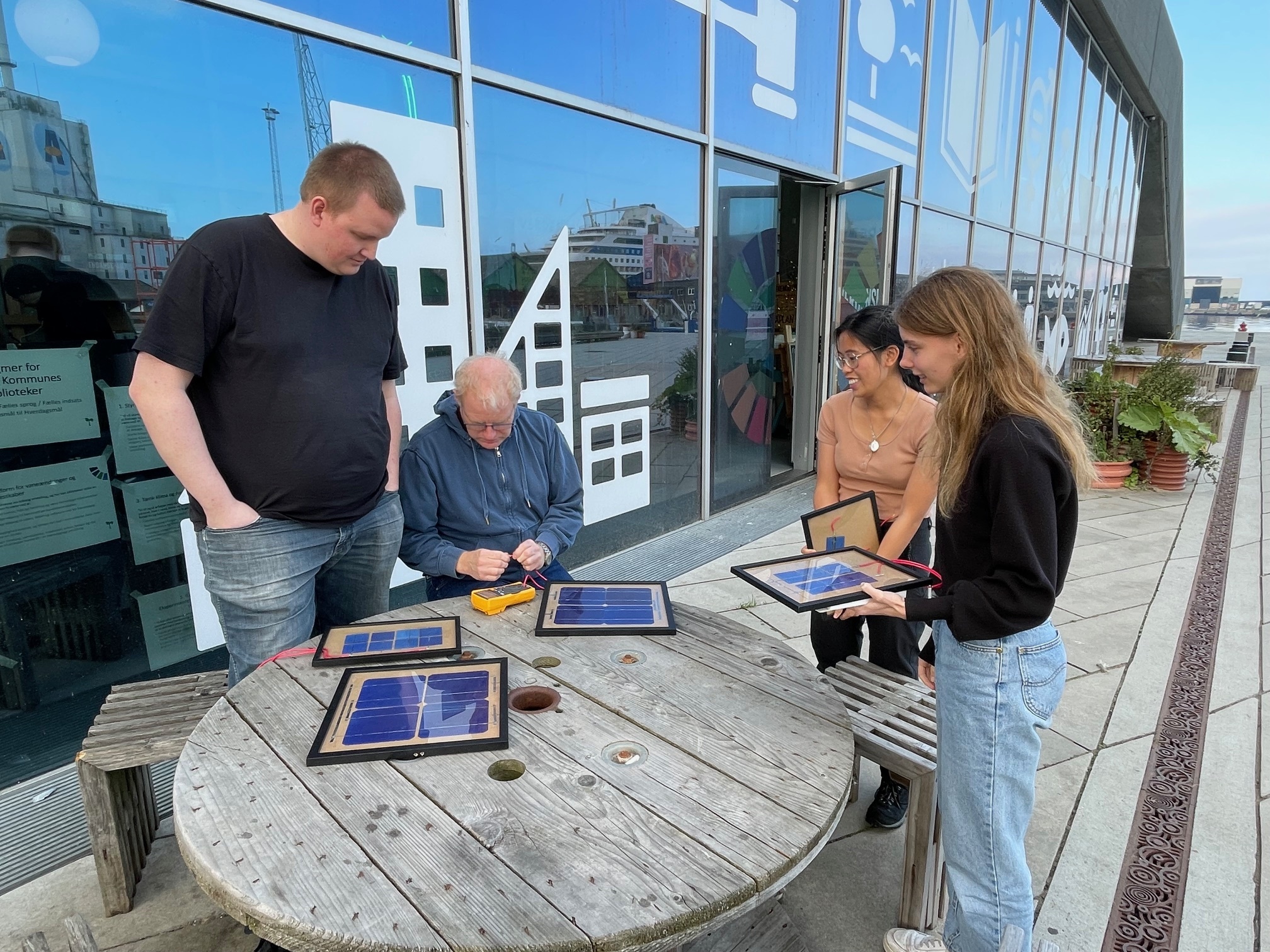
Involving the students required a low price for shares, eventually fixed at 120 euros. The cooperative also limited the number of shares per person to ensure horizontality and democracy. In the end, their strategy paid off: UEF raised 100,000 euros for the PV installation, and has a waiting list for new members.
Advocating for policy change
Despite the project’s launch, UEF is facing ongoing challenges related to its business model due to Danish rules. The cooperative benefits from the prosumer framework in Denmark, which includes the “self-consumption via third party” scheme, allowing consumers and producers to be different entities if they are close geographically.
However, other aspects of this framework create complications. Although Aarhus University’s consumption from UEF’s solar power plant is exempt from the grid tariff, it is required to pay an electricity tax as the prosumer, similar to that paid by non-prosumers, regardless of the social benefits of the project.
Frequent negative electricity prices are also a challenge for the cooperative. UEF would like to sell its excess electricity to the grid, but couldn’t afford to pay in these instances. “We are treated the same way as utilities, and we don’t think it’s fair”, said Zhe.
To facilitate the set-up of future energy communities and to strengthen their business models, the cooperative is arguing for three main policy changes: explicitly including universities in definitions of energy communities, removing the electricity tax under the scheme of self-consumption via third party for energy communities, and relieving energy communities of the need to pay negative electricity prices when they feed electricity to the grid.
Supporting emerging projects
As Zhe explained, the University Energy Community project was always conceived as a pilot, aiming to support more universities to set up energy communities. To achieve this, they organised workshops and published a practical article outlining the ten main challenges faced by the project.
As part of the original project, more energy communities are sprouting up across Europe, in the Technical University of Madrid (Spain), the University of Evora (Portugal), Ljubljana University (Slovenia), and the Forest of Dean District Council (UK). All partners had to be creative, Zhe noted. For example, the project in Spain eventually collaborated with a local school, and Slovenian partners innovated by creating a virtual energy community with the students of the university. “It took time, but eventually everyone found their path”, concluded Zhe.