News
A gender and inclusion strategy to ensure that the energy transition benefits everyone
International Women’s Day invites us to reflect on who gets heard, who gets supported, and who gets to shape our shared future - and who is still left behind. In the energy sector, inclusion means creating spaces where people of all genders, backgrounds, and identities are valued and empowered to participate fully. A truly just energy transition depends on this principle, ensuring that clean, affordable energy is accessible to all as a fundamental human right. Yet too often, women, low-income households, and socially marginalised communities remain excluded from decision-making, despite being among the most affected by energy poverty and climate impacts. Embracing diverse knowledge, experiences, and perspectives is not only a matter of fairness—it strengthens collective solutions and leads to more resilient, equitable outcomes.
Energy communities have the potential to turn inclusion into action. By actively removing financial, social, and institutional barriers, they can become spaces where shared ownership and collective benefit are realities rather than promises.
Committed to addressing overlapping forms of inequality and ensuring that diverse voices are represented in the energy transition, REScoop.eu's Gender Power and Inclusion working group revised its strategy and priorities for the next four years (2025-2029). The strategy aligns with the broader vision of positioning the community energy movement as a leader in equitable participation and democratic representation, ensuring that the energy transition benefits everyone. Structured around five strategic pillars, it will guide REScoop.eu and working group members' work, hopefully inspiring action from energy communities beyond.
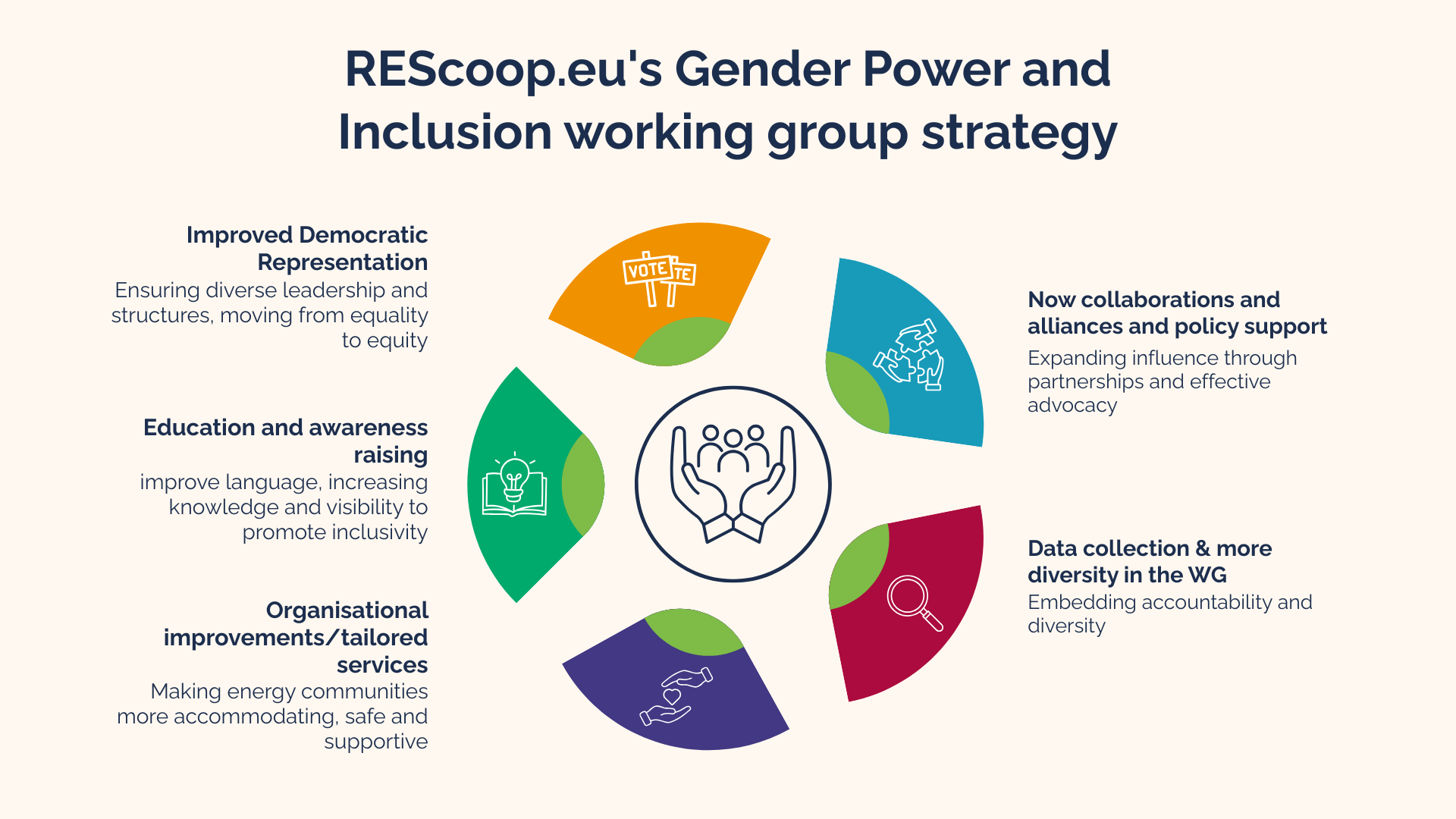
1 - Improved democratic representation
The first pillar is centred around improved democratic representation, with the specific objectives to achieve gender and diversity parity within energy communities’ leadership positions and fundamentally move away from equality to equity in all organisational practices. It also includes the aim to scrutinise our internal organisational culture and internal rules as energy communities to ensure and promote meaningful participation from people with different social and cultural backgrounds. To this end we will dedicate more time and space to listen to the needs of people we want to reach and comply with them, especially those who are currently underrepresented.
2 - Education and awareness raising
Pillar two focuses on education and awareness raising. This includes offering gender and inclusion training, promoting inclusive language and practices, and building a library of case studies and practical toolkits. The group also aims to support education programmes for young people, people with migration backgrounds, and those facing socio-economic challenges. The group’s focus, thus, goes beyond women. Yet, women often encounter challenges when their identities intersect, for instance, in the case of single, migrant mothers. Clear communication, visibility of inclusion work, and the creation of a gender and inclusion observatory are central ambitions.
3 - Implementing organisational improvements
With pillar three, the group commits to implementing organisational improvements. From removing participation barriers to enabling people from different backgrounds to join boards to creating safe and inclusive spaces during assemblies, events and meetings. It also includes a commitment to promote the uptake of targeted initiatives for people experiencing energy poverty (e.g. energy advice, renovation services, low-barrier entry models, solidarity funds etc.).
4 - New collaborations and alliances
Pillar four is about building up new collaborations and alliances. The strategy prioritises partnerships with civil society organisations, social services, and actors such as housing providers to reach underrepresented groups. The working group also stressed the need to promote advocacy for energy justice, welfare integration, and better alignment between social and energy policies.
5 - Data collection and more diversity within the working group
Finally, with the fifth pillar, the group aims to work towards consistent data collection and more diversity within the working group itself. This includes the ambition to conduct annual member surveys, periodic impact assessments, and setting clear KPIs to monitor social impact and inclusion performance. Additionally, the group aims to demonstrate equity through visible actions within member organisations and strengthen diversity by actively inviting underrepresented groups to join the Gender, Poverty & Inclusion Working Group.
While the working group is fully committed to supporting and aligning efforts at the EU level, the real success of this strategy depends on our members getting involved. Their dedication will be key to turning our shared ambitions into lasting change.